Manage Schedules Easily with an Appointment Management System (AMS)
Tuesday, March 10, 2026
Introduction
In the midst of accelerating digital transformation, the service business sector faces a crucial time management paradox. On one hand, many business owners struggle with over whelming queues and an unorganized backlog of manual reservation messages. On the other hand, inefficiencies often lead to valuable time slots being wasted due to last-minute cancellations or poor scheduling coordination. This harsh reality demonstrates that conventional methods—such as manual logging or relying on instant messaging apps—are no longer adequate for businesses aiming to scale professionally.
The heavy reliance on human intervention at every stage of the reservation process creates a high risk of human error, ranging from conflicting schedules (double-booking) to the failure to provide timely reminders to customers. These conditions demand a systematic solution capable of managing time as a business's most valuable asset.
Addressing these challenges, the Appointment Management System (AMS) from RN Tech redefines how businesses manage customer interactions. An AMS is not merely a static digital calendar for recording dates and times. Beyond that, it serves as a business command center that integrates resource availability, precision scheduling logic, and communication automation into a single, unified ecosystem. With the implementation of an AMS, appointment management transforms from an exhausting administrative task into a smart, transparent, and productive operational workflow.
Understanding the Appointment Management System (AMS)
By definition, an Appointment Management System (AMS) is an integrated digital infrastructure designed to automate the entire reservation cycle between service providers and customers. Unlike standard calendar applications which are passive, an AMS functions actively as a digital assistant that manages business resource availability in real-time.
This system serves as a single touchpoint where operational data—such as staff schedules, service durations, and room quotas—is automatically synchronized. With an AMS, the scheduling process that typically consumes time through manual conversations is transformed into an instant, accurate digital transaction, accessible 24/7 without the need for administrative intervention.
Essential Components of an AMS
Deconstructing an Appointment Management System (AMS) means understanding a digital infrastructure that integrates availability data, scheduling logic, and automated communication into a single, cohesive unit. At RN Tech, we define these components not merely as "extra features," but as fundamental elements that ensure business operations run without friction.
Below is an explanation of the essential components of an AMS:
1. Client-Side Booking Interface
This is the primary access point for customers to interact with the system. This component provides direct visibility into an availability calendar that is updated in real-time. Customers can filter service types, select specific personnel or staff, and determine valid time slots. The presence of this interface eliminates the need for manual correspondence (phone calls/chats) for schedule verification, granting full autonomy to the user.
2. Admin Control Dashboard
This component serves as a centralized management panel for business owners and administrative staff. Here, data from all bookings are aggregated and displayed in a consolidated calendar format. Admins have the authority to monitor staff workloads, dynamically adjust operational hours, and manage cancellations or rescheduling. This dashboard becomes the single source of truth for all of the company's appointment activities.
3. Automated Notification Engine
This component automates the entire post-booking communication workflow. Operating based on time-based triggers, the system sends instant confirmations and schedule reminders via WhatsApp or Email. Strategically, this component is critical in reducing "no-show" rates by ensuring customers receive accurate information regarding the time and location of their appointments without requiring administrative intervention.
4. Centralized Customer Database
Every appointment transaction generates data stored in a structured manner. This component records customer identities, previous service history, and specific preferences. This database enables businesses to perform customer behavior analysis and provide more personalized services for future visits, while serving as a vital asset for data-driven marketing strategies.
5. Integration & Payment Hub
A modern AMS must have the capability to connect with external digital ecosystems. This component includes API integrations with third-party calendars (such as Google Calendar) for staff schedule synchronization, as well as connections to payment gateways. This integration allows the system to process down payments or full upfront payments, serving as a guarantee of commitment from the customer's side.
.png)
How an Appointment Management System (AMS) Works
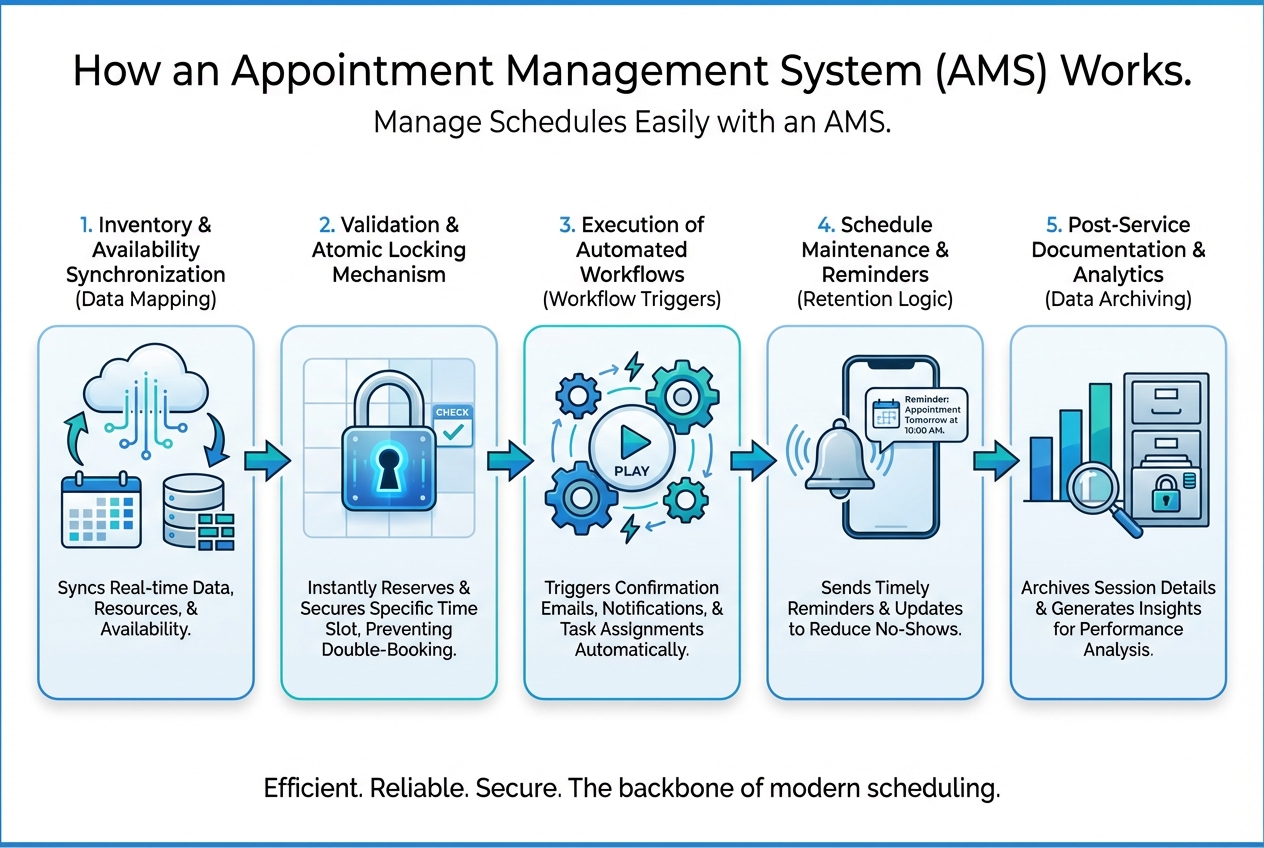
1. Inventory and Availability Synchronization (Data Mapping) The system operates by mapping all business operational parameters into a database. This includes staff working hours, specific service durations, and room capacity. The AMS continuously performs queries against the internal calendar to ensure that only genuinely vacant time slots are displayed to customers. If there is an internal schedule change by an admin, the system updates the customer-side view within milliseconds.
2. Validation and Atomic Locking Mechanism When a customer selects a time slot and clicks the reservation button, the system executes an Atomic Transaction protocol. This is a crucial stage where the database performs a temporary "lock" on that specific slot. This logic ensures that if two customers attempt to book the same time at the exact same second, the system will only validate the transaction that arrived first. This automatically eliminates the risk of double-booking or schedule conflicts.
3. Execution of Automated Workflows (Workflow Triggers) Once the reservation data is successfully verified and stored in the database, the system triggers a series of automated instructions. The AMS immediately sends an API request to messaging services (WhatsApp or Email) to deliver a confirmation notification to the customer. Simultaneously, the system injects the appointment data into the assigned staff member's digital calendar, ensuring all parties receive uniform information without the need for manual input.
4. Schedule Maintenance and Reminders (Retention Logic) The system continuously monitors every schedule entry until the appointment time arrives. Based on predetermined time parameters (e.g., 24 hours or 2 hours before the appointment), the notification engine reactivates to send automated reminders. If a customer cancels through the system, the AMS instantly reopens that time slot for other customers, ensuring business time utility remains optimized.
5. Post-Service Documentation and Analytics (Data Archiving) After the appointment is concluded, the system status is updated to "Completed." This data is then archived into the customer profile. This process allows the system to generate automated performance reports, such as customer attendance rates, peak hour trends, and staff productivity. This information serves as a database for business owners to conduct more accurate operational evaluations.
Strategic Impact on Business Growth
Implementing an Appointment Management System (AMS) is more than just a change of tools; it is a strategic move that directly impacts business profitability and scalability. Once operations are digitized, a business no longer merely survives scheduling chaos but begins to grow on a measurable foundation.
Here are the three primary strategic impacts of an AMS on your business growth:
1. Drastic Reduction in No-Show Rates One of the largest revenue leaks in the service industry is wasted time slots caused by customers forgetting or canceling last minute without notice. An AMS mitigates this risk through an Automated Reminder Engine. By sending scheduled reminder notifications via WhatsApp or Email, customer attendance discipline increases significantly. As a result, service time utility remains maximized, and potential revenue loss from empty slots is kept to a minimum.
2. Escalating Customer Satisfaction through Self-Service Reservations In the digital era, customer convenience is a key determinant of loyalty. Providing customers 24/7 access to view, select, and confirm their own schedules creates a frictionless experience. Customers are no longer restricted by office hours or forced to wait in queues for admin chat replies. This autonomy projects a strong image of professionalism, builds trust, and ultimately increases long-term customer retention.
3. Optimization of Staff Productivity and Efficiency Without an AMS, staff often spend 30-40% of their working time handling manual scheduling administration. With AMS automation, this administrative burden is shifted entirely to the system. Consequently, staff schedules are organized automatically with high precision, complete with pre-set breaks or preparation times. This allows staff to focus fully on the quality of core services, boosts morale by reducing manual coordination pressure, and ensures that every human resource operates at their optimal capacity.
| Strategic Pillar | The Manual Challenge (Before AMS) | The AMS Solution (After Implementation) | Business Growth & Scalability Impact | |
| 1 | Revenue Recovery | High No-Show Rates: Significant revenue leakage occurs when customers forget appointments or cancel last minute because there is no consistent follow-up system in place. | Automated Reminder Engine: The system automatically sends scheduled notifications via WhatsApp or Email, ensuring customers are reminded of their slots without manual effort. | Maximizes Billable Hours: Drastically reduces empty time slots, ensuring that potential revenue is captured and service utility remains at its highest possible level. |
| 2 | Customer Experience | Booking Friction: Customers are limited by office hours and often face long wait times for admin staff to reply to chats or answer phone calls to confirm a slot. | 24/7 Self-Service Reservations: Provides customers with full autonomy to view real-time availability and book their own appointments instantly at any time of the day or night | Increases Customer Loyalty: Creates a modern, frictionless professional image that builds trust, improves satisfaction, and significantly increases long-term customer retention |
| 3 | Staff Productivity | Administrative Overload: Staff typically spend 30% to 40% of their workday managing manual scheduling, resulting in human error and high coordination pressure. | Complete Process Automation: The system takes over the entire administrative burden, automatically organizing schedules with precision, including pre-set breaks and prep times. | Optimizes Human Resources: Frees your team to focus 100% on the quality of core service delivery, boosting morale and allowing the business to scale without increasing headcoun |
Conclusion: Moving Toward Operational Precision with RN Tech
In an era where speed and accuracy have become the new benchmarks for customer service, maintaining conventional scheduling methods is no longer just an option—it is a strategic risk. The Appointment Management System (AMS) from RN Tech is not merely an additional software tool; it is the heart of modern digital transformation for service-based businesses. By integrating robust components with high-precision workflows, our solution transforms repetitive administrative hurdles into a tangible competitive advantage for your business.
The efficiency created by RN Tech’s system allows you to stop worrying about daily logistical details and start focusing on developing your larger business vision. We believe that the right technology is a strategic investment that not only saves time but also fundamentally enhances your brand's value and professionalism in the eyes of your customers. With RN Tech, you are not just adopting a system; you are building a stable and measurable foundation for future growth.
FAQ
1. Can this AMS be integrated with my existing website?
Absolutely. The AMS from RN Tech is designed as a flexible solution. We can integrate the booking interface directly into your current website through API integration or custom widgets, without requiring any changes to your existing website structure.
2. What if my staff have different schedules every week?
Our system is highly dynamic. Admins have full control to set individual working hours for each staff member. You can adjust weekly schedules, set holidays, or add instant break blocks, all of which will be immediately synchronized on the customer-facing view.
3. Do customers need to download a specific app to make a booking?
No. To ensure a frictionless user experience, customers can make reservations directly through their mobile or desktop browser. This ease of access is the key to increasing the volume of digital reservations.
4. How does the system prevent last-minute cancellations?
In addition to automated reminders (WhatsApp/Email), our system supports Payment Gateway integration. You can enable down payment (deposit) or full upfront payment features. Psychologically, this increases customer commitment to show up on time.
5. Is my customer data secure within this system?
Data security is a top priority at RN Tech. All customer data is encrypted and stored on servers with high security standards. We ensure that your business database is only accessible to authorized personnel based on the access levels you define.