Understanding AI Agents 2026: Workflow, Challenges, and the Future of Automation
Monday, March 16, 2026
Introduction
Over the past few years, we have grown accustomed to using AI as a sophisticated answering machine. However, by 2026, the technological landscape has shifted from mere conversational intelligence to "actionable" intelligence. Welcome to the era of the AI Agent.
While previous technologies focused on providing instructions, AI Agents go a step further by acting as assistants with "digital hands." The difference is profound: an AI Agent doesn’t just tell you how to complete a task; it actually executes it for you autonomously in the background.
Imagine a system capable of reasoning, planning, and acting independently—from managing complex schedules to handling client correspondence—while you focus on high-level strategy and creativity. An AI Agent is no longer just an information retrieval tool; it is a digital colleague that liberates humans from tedious administrative routines, elevating productivity to unprecedented levels.
Let’s dive into the architecture behind this technology and why the right infrastructure foundation is the ultimate key to its success.
What is an AI Agent?
An AI Agent is an artificial intelligence system that does not merely answer questions but possesses the capability to take autonomous actions to achieve specific goals.
The AI Agent represents a paradigm shift from passive artificial intelligence to an active digital entity capable of deep reasoning to decompose complex objectives into logical work sequences. Unlike conventional language models that operate solely within the scope of text, these agents possess the technical integration to utilize various digital tools—such as email systems, calendars, and databases—to execute tasks in the real world.
Their core strength lies in functional autonomy, where the system can make decisions and self-correct its steps until the final result is achieved, without requiring repetitive manual instructions from the user. Ultimately, an AI Agent is the realization of action-oriented intelligence—a system designed not just to speak or provide information, but to work and complete end-to-end processes.
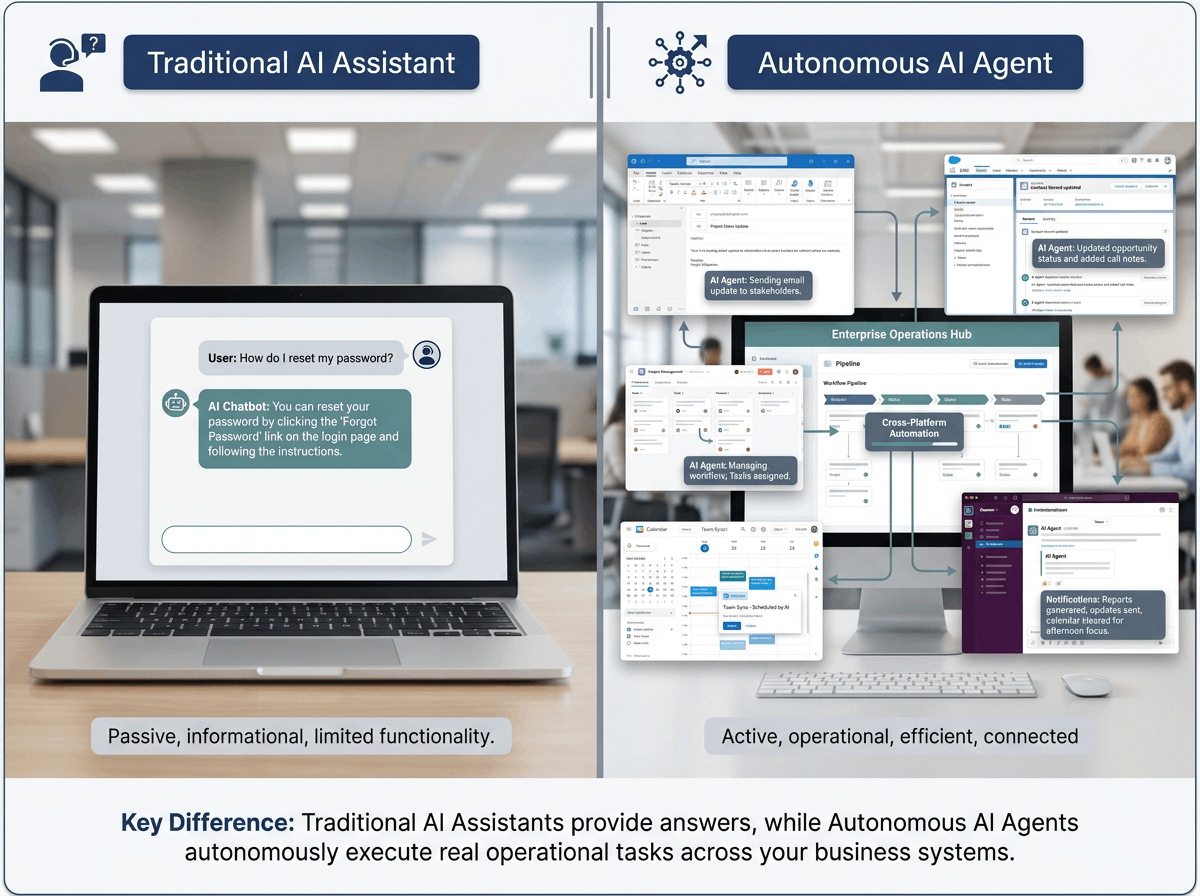
Traditional AI responds to prompts, while AI Agents autonomously execute tasks across connected systems.
How AI Agents are Formed
The creation of an AI Agent stems from a strategic fusion of high-level reasoning architecture and functional access to digital ecosystems. Professionally speaking, these agents take shape when a Large Language Model (LLM) ceases to function as a static answering machine and is instead given a "mandate" through deep system instructions to act as an autonomous subject.
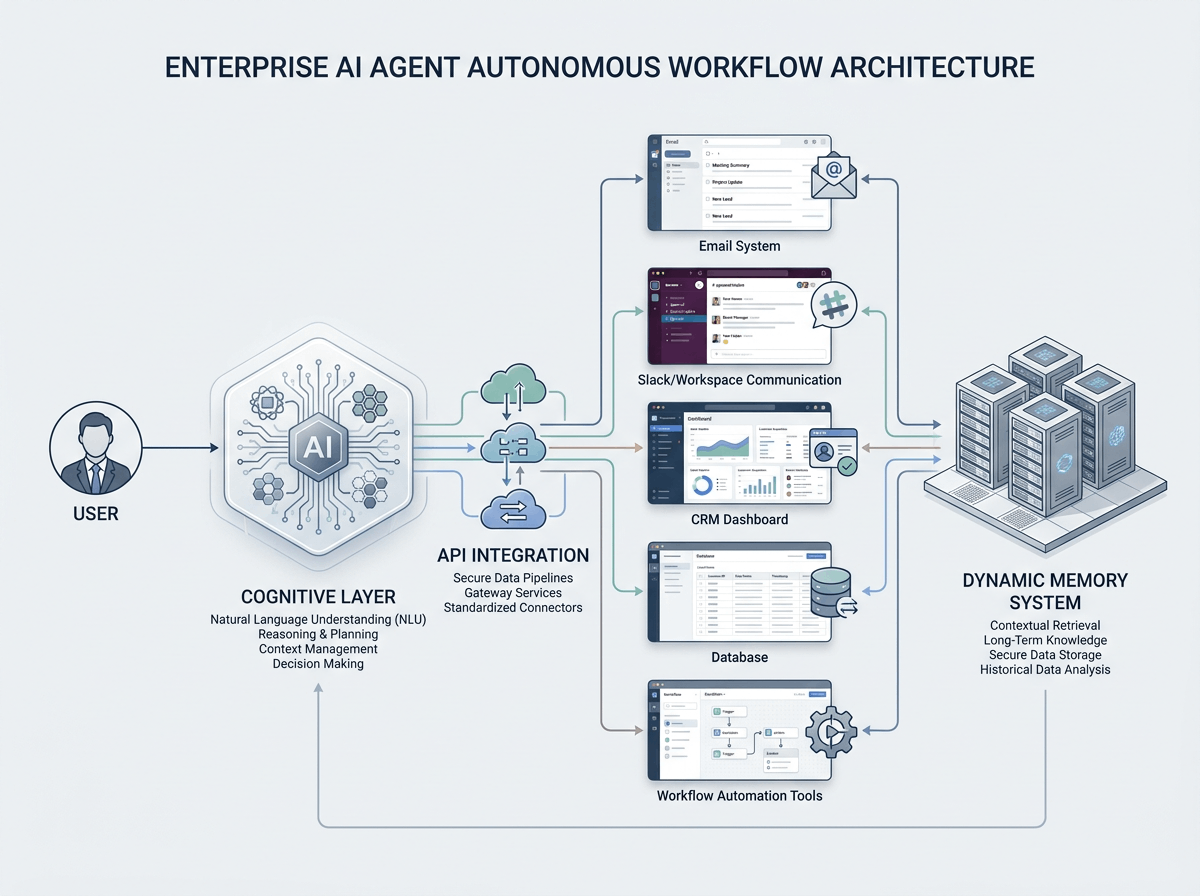
AI Agent architecture connecting reasoning, APIs, enterprise applications, and persistent memory into a unified autonomous workflow.
Core Components of an AI Agent
The functional structure that enables an AI Agent to operate as a cohesive unit consists of three crucial layers:
- Cognitive Layer: Acts as the primary command center responsible for task decomposition—breaking down large objectives into logical, measurable sequences of work.
- External Interface Integration (API): The component that provides the agent with the "physical capacity" to interact with and drive other applications, ranging from database management to public communication systems.
- Dynamic Memory System: The architecture that allows the agent to store both short-term and long-term context, ensuring every action taken remains synchronized with the original established goals.
However, behind this technical sophistication lies an aspect that requires high precision during the development process. Because the agent operates through a vast "reasoning space" to determine its own actions, an organic space of uncertainty emerges. The autonomy that serves as the agent's primary strength inherently creates a gap where instructions might be translated with interpretations that differ from the idealized scenario envisioned.
How AI Agents Operate in a Real-World Ecosystem
Once we understand the cognitive structure and physical layers, a question arises: how do all these components collaborate upon receiving our instructions? The workflow of an AI Agent is not linear like traditional software; instead, it is a dynamic cycle that continues until the objective is met. This process typically follows a pattern of Perception, Planning, and Execution.
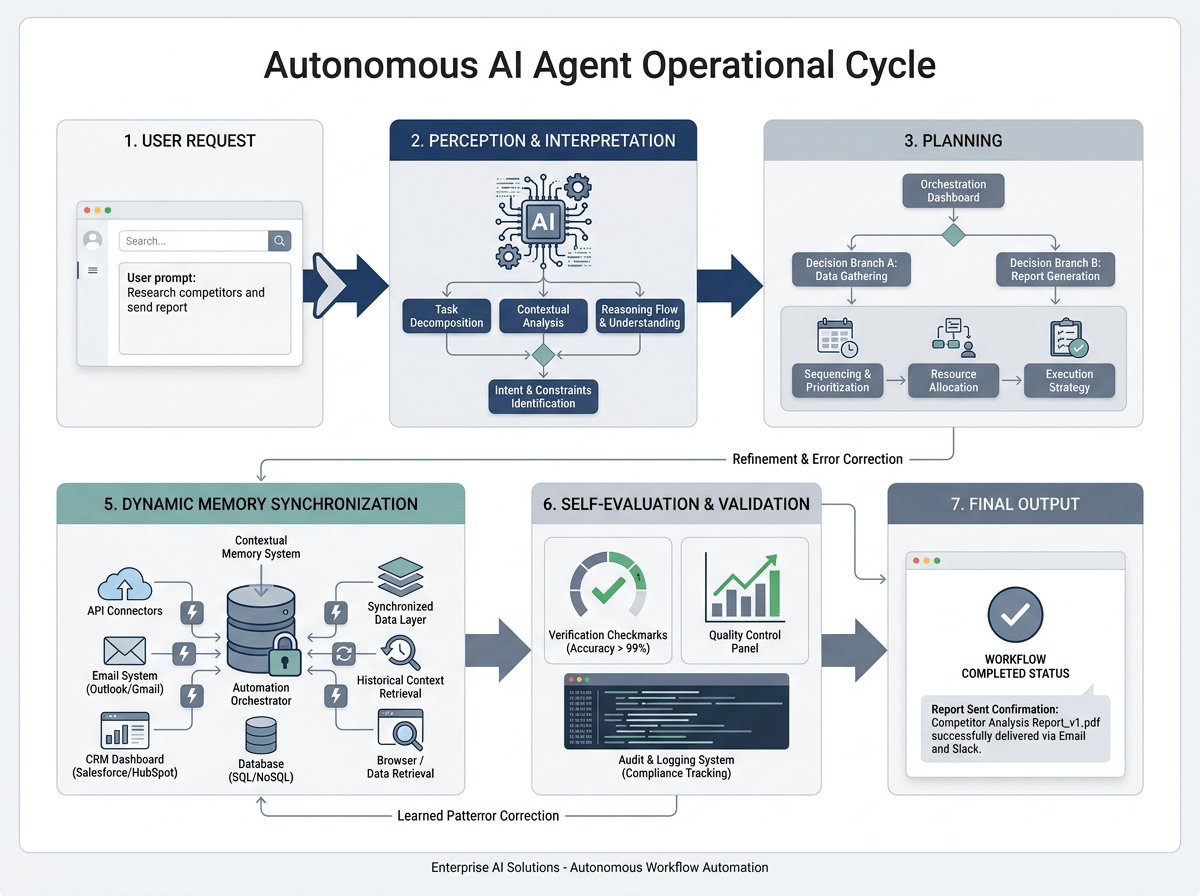
AI Agents operate through a continuous cycle of reasoning, execution, memory synchronization, and self-evaluation.
1. Interpretation and Decomposition Phase
The cycle begins when you provide an ultimate goal, for example: "Conduct competitor research and send the summary to the marketing team via Slack." Instead of just performing a simple search, the agent's Cognitive Layer performs decomposition. It breaks the command into sub-tasks:
- Identifying the primary competitors.
- Performing web crawling to gather the latest data.
- Summarizing key points using its natural language capabilities.
- Accessing the Slack API to deliver the message to the correct channel.
2. Tool and API Orchestration
At this stage, the agent begins using its "digital hands." Through API Integration, the agent moves seamlessly from one environment to another. It might open a browser for research, switch to a data processing app to organize tables, and finally navigate to a communication platform. Remarkably, if the agent encounters an obstacle—such as an inaccessible website—it will not stop. It autonomously seeks an alternative path without waiting for new instructions from you.
3. Self-Evaluation and Memory Synchronization
Throughout the process, the Dynamic Memory System ensures the agent stays on track. Every piece of information found during the research phase is stored to be utilized when drafting the summary.
Before delivering the final output, the AI Agent performs an internal quality check (self-reflection). It compares its work against the original "mandate" provided. If the results do not meet the expectations or parameters you set, it will instantly recalibrate and refine its work plan.
Recommended AI Agent Tools & Implementation
To actualize the concept of a functional agent, we require tools capable of unifying the cognitive "brain" with the executive "hands." By 2026, the selection of tools has evolved into a mature ecosystem. Below are the top recommended tools based on specific implementation needs.
1. For No-Code Business Automation: Zapier Central & Make
- Zapier Central: An industry leader for creating autonomous AI Agents integrated with thousands of business applications. You can train these agents with specific Live Data, allowing them to monitor triggers and execute background actions continuously.
- Make: Offers granular control for complex workflows. It is ideal for building a digital "nervous system" that requires intricate branching logic between AI reasoning and external APIs.
2. For Technical Control & Data Sovereignty (Advanced Orchestration): n8n
- n8n: Moving beyond standard automation tools, n8n now provides a dedicated AI Agent node powered by the LangChain ecosystem through a visual interface. It is the premier choice for businesses prioritizing data security, as n8n allows you to run agents on your own infrastructure (self-hosted). With n8n, you can build agents equipped with persistent memory and logical reasoning capabilities to execute highly technical and complex workflows.
3. For Developers & Open Ecosystems: CrewAI & LangGraph
- CrewAI: A Python-based framework designed for "multi-agent orchestration." It allows you to deploy several agents with distinct specializations (e.g., a Research Agent and a Technical Writer Agent) that collaborate to complete large-scale projects.
- LangGraph: Part of the LangChain ecosystem, focusing on agents with cyclic reasoning and persistent memory. It is highly effective for tasks requiring self-correction and iterative loops.
3. For Integrated Productivity: Microsoft Copilot Studio
- The premier choice for enterprises already operating within the Microsoft 365 ecosystem. It enables the creation of custom agents that function natively within Teams or Outlook, securely accessing SharePoint data to execute internal corporate tasks.
Pro-Tip for Integration
To ensure these tools operate at peak efficiency, your underlying digital infrastructure must be optimized. High latency or "bloatware" in your primary web systems can disrupt the API communication between the AI's "brain" and its executive "hands."
Workflow Narrative: AI Agents in Action
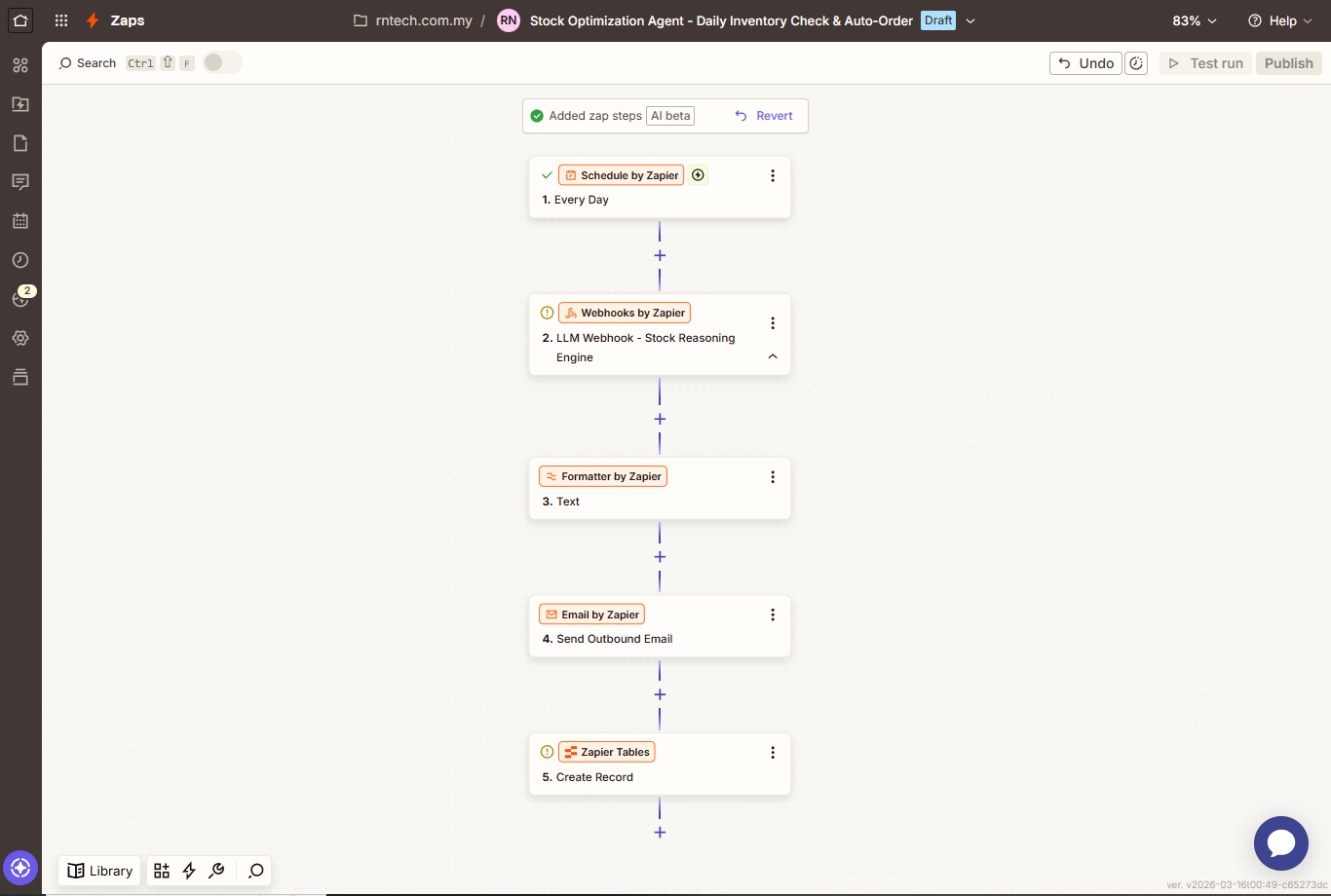
To visualize how the tools mentioned above function, let’s look at a scenario using a combination of Zapier Central (as the executor) and GPT-4o (as the Cognitive Layer).
Imagine you are an Operations Manager. You configure an AI Agent in Zapier Central with a specific system mandate (System Prompt): "You are the Stock Optimization Agent. Your task is to ensure that the inventory of Product A never falls below 50 units. You have access to the Warehouse System API and the Supplier Email API."
The following autonomous workflow then operates in the background:
- Perception (Memory & API): Every day at 9:00 AM, the agent automatically queries the Warehouse System API. Its Dynamic Memory System retains the specific threshold you set (50 units).
- Reasoning (Cognitive Layer): One day, the agent detects that the stock for Product A has dropped to 45 units. The AI "brain" processes this data and reasons: "Stock is < 50. Action required: Generate a new purchase order for 100 units to Supplier X."
- Planning & Execution (The "Hands"): The agent doesn't just blindly send an email. It develops a logical plan:
- Step 1: Draft a formal purchase order email using professional language (LLM capability).
- Step 2: Use the Email API to send that draft directly to Supplier X.
- Self-Evaluation: Once the email is sent, the agent verifies the API server response to ensure there were no delivery errors. It then logs this entire transaction in an activity report for your future audit.
This entire process occurs without you ever needing to open a warehouse dashboard or type a single email. This is the true power of action-oriented AI Agents.
The Crucial Role of Infrastructure: Why RN Tech is Key
The effectiveness of an AI Agent implementation depends heavily on the stability of your digital infrastructure. Without a lean website ecosystem free of bloatware, API communication will be hindered by latency issues that disrupt automation performance.
This is where RN Tech plays a vital role as your professional technical partner. We ensure that the "home" for your AI Agent is built on high-performance architecture with rigorous security layers, guaranteeing that every autonomous process runs smoothly, securely, and without fundamental technical hurdles.
Challenges: Autonomy Amidst Spaces of Uncertainty
While the mechanics described above offer revolutionary efficiency, we must recognize that this autonomy operates within a vast "reasoning space." An agent's freedom to determine the "fastest path" toward a goal introduces several crucial challenges that must be mitigated:
- The Risk of Functional Hallucination Unlike standard chatbots that might only provide incorrect text, an AI Agent can experience "functional hallucination"—a condition where the agent believes it has successfully executed a task in an external application, despite a logic failure occurring in the background. Without supervision, minor errors during the reasoning phase can accumulate into significant failures during real-world execution.
- Security and Privacy Complexity Granting an agent a "mandate" to access sensitive tools—such as email, client databases, or local payment systems (like DuitNow or FPX)—opens new security vulnerabilities. The challenge lies in ensuring that the agent is not manipulated by malicious external instructions (prompt injection), which could lead to leaks of sensitive corporate data.
- Instruction Ambiguity An AI Agent's autonomy inherently creates a gap where an instruction might be translated with an interpretation that deviates from the ideal scenario. When facing ambiguous data, an agent might make independent decisions that do not align with business ethics or standard company protocols if not restricted by precise parameters.
- Dependency on Infrastructure Stability An AI Agent’s intelligence becomes paralyzed if its supporting infrastructure is inadequate. Technical issues such as latency (delayed response), server downtime, or cluttered website code (bloatware) can break the communication chain between the AI "brain" and its digital "hands" (APIs).
Consequently, the primary challenge is no longer just running an AI, but building strict Guardrails. This is where a solid digital foundation becomes the deciding factor in whether your AI Agent becomes a productive asset or a technical liability.
Infrastructure Solutions: Building a Foundation for Active Intelligence
To overcome the various challenges of autonomy and technical risks, an AI Agent requires more than just "smart" instructions; it needs a resilient digital ecosystem. The right infrastructure solution is the key that transforms AI potential into stable business performance.
The following are the pillars of infrastructure solutions that must be adopted:
- Low-Latency Architecture & Anti-Bloatware AI Agents operate by making repetitive API calls within a single workflow. Website infrastructure must be optimized for maximum speed by removing unnecessary code (bloatware). A lightweight website ensures instant API responses, allowing the agent to complete its "Perception-Action" cycle without delays that could trigger system failures.
- Implementation of API Guardrails This solution involves building security layers between the AI Agent and sensitive applications. By setting precise access boundaries, we ensure the agent only performs authorized actions. This mitigates the risk of unexpected actions that could damage databases or violate client privacy.
- Real-Time Monitoring and Logging An ideal infrastructure provides a monitoring dashboard to track every digital footprint left by the agent. With a clean logging system, every decision made by the AI can be audited. If a logic failure occurs, the system can provide instant alerts or automatically terminate access for security purposes.
- Hybrid Integration with RN Tech This is where RN Tech serves as a comprehensive solution. We do not just build websites; we design the "Digital Nervous System" ready to support AI Agents. Through clean coding, server optimization, and reinforced security protocols, RN Tech ensures your infrastructure is not merely a display, but a powerhouse engine for future automation.
With a foundation built by professionals, your AI Agent will no longer operate in uncertainty but in a controlled, fast, and fully secure environment.
Conclusion: Securing Digital Sovereignty Through Future-Ready Infrastructure
We have to recognize that the digital landscape has shifted radically. Today, AI is no longer just a clever tool to chat with; it is a proactive entity holding the "keys" to your business operations. The efficiency potential offered by AI Agents is extraordinary—from slashing administrative tasks to automating complex operational decisions.
However, as tech leaders and business owners, there is one crucial reality we must agree on: Intelligence without stability only breeds new risks.
Handing over critical business mandates to an AI Agent on top of a slow website ecosystem—one cluttered with bloatware or lacking robust security—is like driving a cutting-edge supercar on a deeply potholed road. The result? Broken API communication, surging latency, and the constant threat of "functional hallucinations" that can actively disrupt your operations.
This is exactly where RN Tech steps in. We operate not just as a standard web development firm, but as a strategic partner engineering the Digital Nervous System your business requires. We ensure that before you step into the era of autonomous AI Agents, your underlying digital infrastructure is completely stripped of bloatware, optimized for ultra-low latency, and fortified with ironclad API Guardrails.
With RN Tech, you aren't just chasing the 2026 tech curve—you are building a secure, scalable digital sovereignty designed for tangible business performance.
Ready to Build a Secure AI Agent Foundation for Your Business?
Don't let legacy infrastructure bottleneck the future of your company's automation. Let’s discuss how we can optimize your web ecosystem and API integrations to seamlessly and securely host the next generation of AI workloads.
👉 Schedule a Consultation with RN Tech
Contact our team today to request a complimentary Website Performance Audit and AI Readiness Assessment.
FAQ
1. Why are AI Agents considered digital workers rather than just tools?
Because AI Agents possess the ability to reason through instructions, plan workflow steps, and execute them using digital tools (APIs) until the task is complete—all without needing manual guidance at every stage.
2. How secure is company data when accessed by an AI Agent?
Data security depends entirely on the infrastructure and the "guardrails" put in place. Through professional security configurations by RN Tech, agent access can be strictly locked to only the specific data scope required for a given task.
3. What is the impact of a bloatware-heavy website on AI Agent performance?
AI Agents operate through intense and repetitive data communication. A slow website or cluttered code structure creates latency, which can lead to synchronization failures or the disruption of autonomous workflows mid-process.
4. Does business operation still require human supervision?
Although AI Agents can work autonomously, the human role remains crucial as the mandate-giver and policy overseer (Human-in-the-loop), especially for final validation in strategic or mission-critical business processes.