Navigating AI in Modern Cybersecurity: Strategies for Protecting Malaysian Corporate Digital Assets
Tuesday, March 3, 2026
Entering 2026, Malaysia is undergoing a highly accelerated phase of digital transformation, driven by the adoption of Artificial Intelligence (AI) across nearly all layers of business operations. This technology is no longer functioning merely as a supporting tool, but has become a core infrastructure component in decision-making, process automation, and large-scale data management.
On the other hand, this shift is also fundamentally reshaping the risk landscape. Cyberattacks are no longer static or opportunity-based; instead, they are evolving into AI-driven adaptive threats. This creates a condition where both defensive systems and offensive operations are evolving at a balanced and continuous pace.
Within the Malaysian corporate context—across financial services, e-commerce, and professional sectors—the primary challenge is no longer simply about "preventing attacks," but about building digital resilience that can adapt in real time to a continuously evolving threat ecosystem.
AI in Cybersecurity: A Dual-Use Technology Landscape
At its core, AI operates through a sophisticated matrix of large-scale pattern recognition, autonomous learning, and predictive decision-making. These highly advanced capabilities create a profound dual-use technological landscape, delivering a resilient shield for defensive teams while simultaneously serving as an efficiency multiplier for offensive cyber operations.
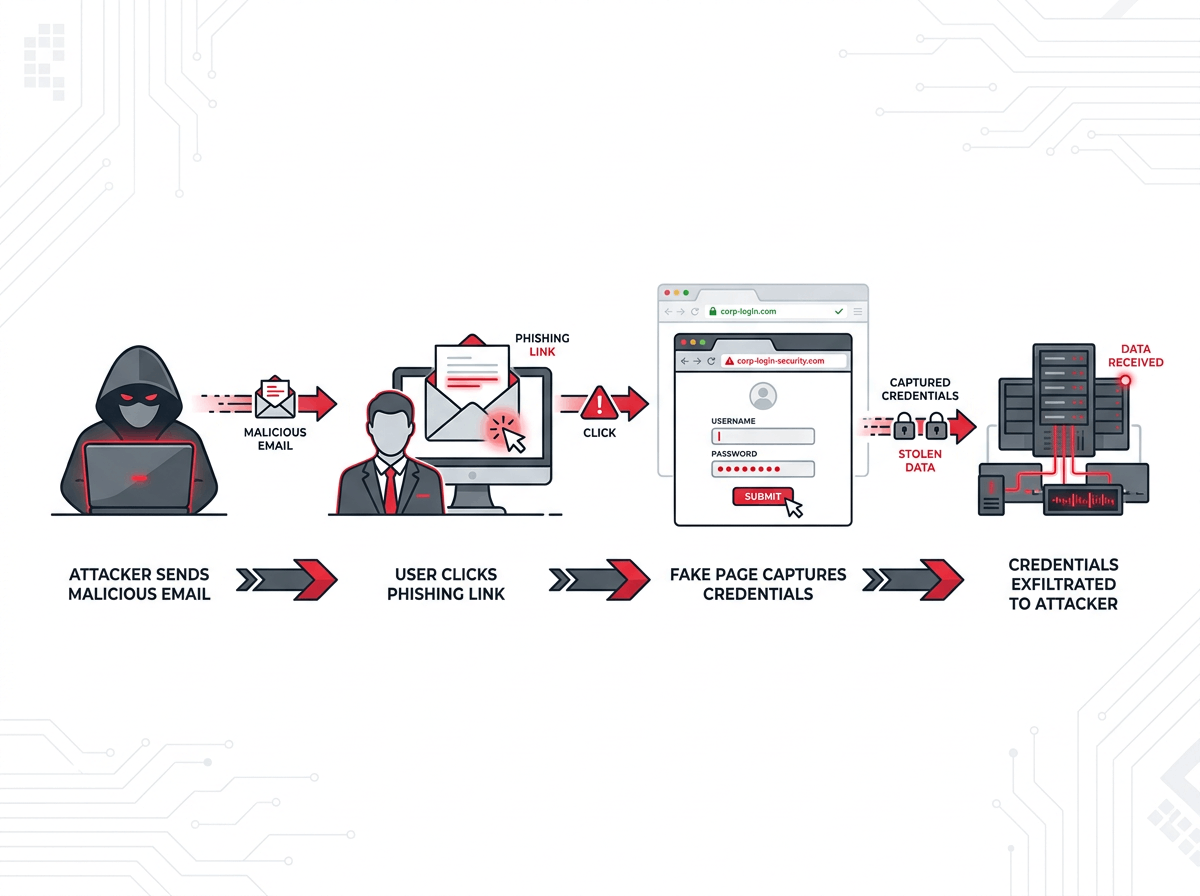
The diagram above maps the traditional phishing attack vector, which modern artificial intelligence has significantly accelerated. In today's threat landscape, AI automates the initial email delivery with flawless, hyper-personalized messaging that easily deceives targets. Furthermore, the fake capture pages and data exfiltration processes are engineered dynamically, allowing stolen credentials to bypass static security perimeters instantly.
Defensive Advantage: Real-Time Intelligence Systems
On the defensive side, AI acts as a continuously operating security intelligence layer that processes and performs real-time analysis of large-scale system logs. Utilizing User Behavior Analytics (UEBA), the framework immediately flags subtle behavioral anomalies and identifies zero-day threats based on dynamic behavioral patterns rather than relying on outdated signature databases. This shift fundamentally transitions an organization's cybersecurity posture from reactive monitoring to proactive threat prevention.
Offensive Evolution: AI-Powered Cyberattacks
Conversely, cybercriminals are aggressively leveraging these identical technological advancements to enhance attack sophistication. By weaponizing Generative AI, threat actors can now engineer highly convincing phishing campaigns written with flawless linguistic patterns. This danger is further compounded by the deployment of voice Deepfake technologies designed to impersonate corporate leaders, alongside the rise of polymorphic malware that dynamically alters its structure to systematically bypass traditional perimeter controls.
Corporate Threat Scenario and Critical Industry Exposure in Malaysia
To put this into perspective, consider a real-world scenario where a financial services organization receives an urgent fund transfer request from a regional CFO. The message appears completely legitimate because it matches the company's internal communication style perfectly, leverages AI-generated identity replication, and includes a real-time voice Deepfake verification. Without multi-layer authentication and behavioral anomaly detection systems, such sophisticated social engineering attacks can result in immediate, catastrophic financial loss.
This volatile threat environment creates critical exposure risks across key industrial sectors in Malaysia:
- FinTech & Banking: Operates as a primary target for automated account takeover (ATO) actions and malicious transaction manipulation.
- E-Commerce & Retail: Faces intense vulnerabilities regarding payment gateway exploitation and large-scale customer data breaches.
- Logistics & Supply Chain: High exposure to operational ransomware attacks capable of completely halting physical distribution networks.
- Corporate Services: Susceptible to covert internal data theft and strategic digital system sabotage.
RN Tech Cyber Defense Framework
Faced with these high-velocity risks, RN Tech operates as a cybersecurity architecture partner, not just a service provider, delivering comprehensive, end-to-end digital resilience systems through four distinct structural layers:
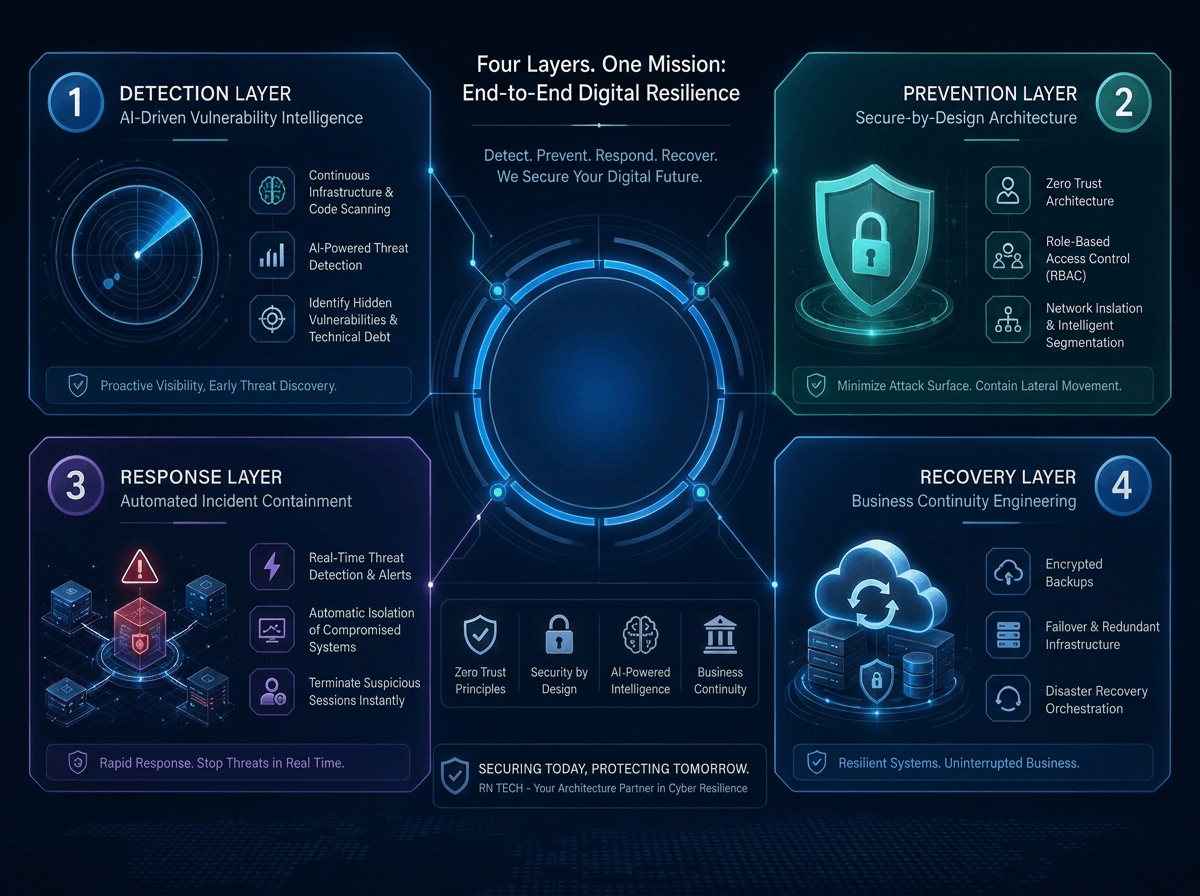
Figure illustrates the RN Tech Cyber Defense Framework, a four-layer security architecture designed to ensure continuous enterprise resilience. The system integrates Detection, Prevention, Response, and Recovery layers into a unified orchestration model that enables real-time threat visibility, access control enforcement, automated incident mitigation, and secure disaster recovery.
1. Detection Layer – AI-Driven Vulnerability Intelligence
We implement continuous scanning of your enterprise infrastructure and core codebases. Powered by smart detection algorithms, our team hunts down hidden security weaknesses and eliminates legacy technical debt (bloatware) before exploitation can occur.
2. Prevention Layer – Secure-by-Design Architecture
We fundamentally re-engineer system frameworks following strict Zero Trust principles. By enforcing robust Role-Based Access Control (RBAC) and network isolation (intelligent segmentation), we ensure that lateral attack movement is strictly contained if an anomaly occurs.
3. Response Layer – Automated Incident Containment
Velocity is paramount in risk mitigation. This layer guarantees immediate isolation of compromised systems, automatic termination of suspicious user sessions, and real-time security alerts to neutralize threats before they can propagate across the enterprise network.
4. Recovery Layer – Business Continuity Engineering
We construct a resilient infrastructure fortified by smart backup architectures (failover systems). Backed by encrypted backups and structured disaster recovery orchestration, we ensure that your business operations and digital transactions maintain seamless continuity during any disruption.
The Future of Cybersecurity: Human-AI Collaboration
While AI exponentially accelerates telemetry detection and incident response, human intelligence remains an irreplaceable ethical anchor and strategic guide. Humans are fundamentally required for contextual judgment during complex crises, ethical decision-making, and high-level strategic risk oversight.
RN Tech bridges the operational gap between machine intelligence and human oversight, enabling Malaysian organizations to build secure, adaptive, and future-ready digital ecosystems.
Ready to Secure Your Business Digital Infrastructure Against AI-Driven Threats?
In an era where cybercriminals can exploit system vulnerabilities in milliseconds, relying on standard perimeter protection is a major risk. Do not wait until your corporate web architecture or databases become the next target.
Mitigate your cyber risks today. Contact the cybersecurity architecture experts at RN Tech to schedule a deep-dive consultation and a comprehensive vulnerability assessment for your enterprise ecosystem.
📞 Secure Your System – Consult with RN Tech Cyber Experts Now
Frequently Asked Questions (FAQ)
1. Can AI replace internal IT security teams?
No. AI enhances and accelerates overall security capabilities, but it does not replace the crucial need for human oversight, context interpretation, and high-level strategic decision-making.
2. What is the biggest risk of using unmanaged AI tools in enterprises?
The primary risk is accidental data leakage and the uncontrolled exposure of sensitive corporate information through public AI platforms, which creates new security blind spots due to weak access governance.
3. How does RN Tech mitigate AI-driven attacks like deepfake and automated phishing?
We mitigate these threats through the deployment of AI-based threat detection systems, multi-layer identity validation protocols, and continuous behavioral anomaly monitoring across network data flows.
4. How is RN Tech different from traditional cybersecurity providers?
RN Tech focuses heavily on architecture-level security design and high-performance system engineering, rather than simply deploying isolated security tools or standard software fixes.
5. What happens if a major cyber incident occurs?
Our comprehensive business continuity systems and automated failover infrastructure stand ready to instantaneously take over operations, ensuring seamless operational continuity throughout the recovery process.