Sunday, March 29, 2026
WordPress Transformation 2026: Fast, Lightweight, and Future-Ready Website Strategies

Many businesses are trapped with 'obese' WordPress sites—cluttered with heavy plugins and sluggish page builders. This article discusses core updates, real-world challenges, and implementation strategies with RN Tech to transform your website into a responsive, secure, and scalable digital asset in the 2026 era.
Introduction
As we enter 2026, the paradigm of website management has completely shifted. While the primary focus for business owners was previously on complex visual aesthetics, the focus has now moved toward architectural efficiency.
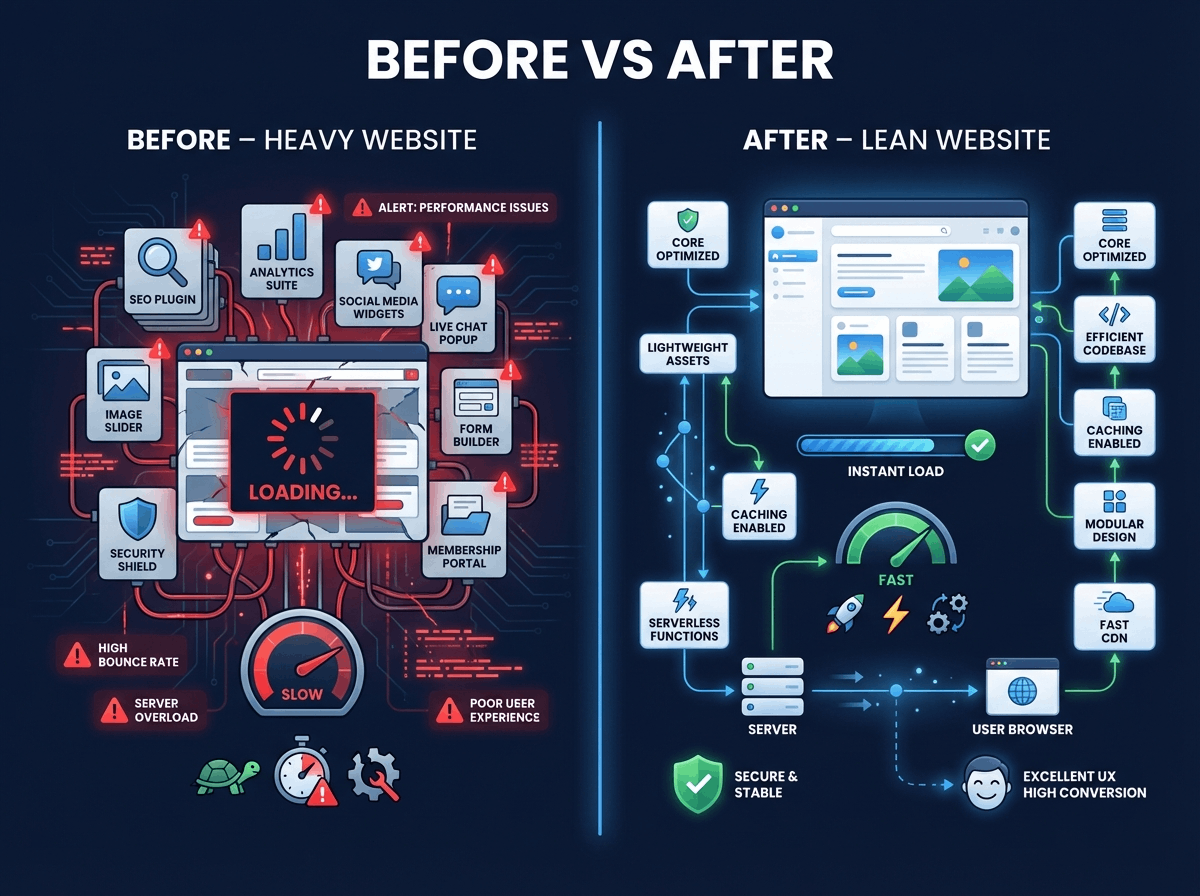
Many businesses today are trapped with "obese" WordPress sites—cluttered with overlapping plugins and heavy page builders—which are slowly dragging down their sales conversions and search rankings.
This article will thoroughly explore how the 2026 WordPress evolution offers solutions to move away from sluggish legacy structures. We will break down the latest technological updates, often-overlooked technical challenges, and tactical strategies to transform your website into a lightweight, fast digital asset ready to compete on a global scale.
WordPress 2026 Core Updates
In 2026, WordPress is no longer just focusing on ease of use—but also on performance, efficiency, and readiness for the AI era. The latest core updates bring significant changes designed to eliminate "system overhead" and enhance the overall user experience.
1. High-Performance Order Storage (HPOS) Optimization
Through integration with WooCommerce, the data storage system now utilizes a specialized structure that is far more efficient. As a result, transaction processing can increase by up to 50%, providing a faster, more stable, and responsive shopping experience for customers.
2. Interactivity API & Native Blocks
WordPress is now reducing its dependency on third-party JavaScript by introducing the Interactivity API. Interactive elements can run natively, thereby reducing the load on the browser and significantly increasing page rendering speeds.
3. AI-Ready Infrastructure
Designed for the AI era, WordPress 2026 allows for lighter and more efficient integration with models such as GPT-40 and Gemini. This opens up opportunities to provide smart features without having to rely on heavy plugins that could potentially slow down the system.
.png)
These changes are not merely feature upgrades, but a fundamental shift in how we build websites. In the past, performance was often compensated by adding more plugins or external tools. However, in 2026, this approach is gradually being abandoned.
Modern websites are now expected to operate more efficiently from within—not by relying on external additions. In other words, strength no longer comes from how many features are installed, but from how well the core system performs.
This is where the evolution of WordPress becomes more apparent. It is not only about major updates, but also about refinements across multiple layers of the system that collectively enhance overall performance.
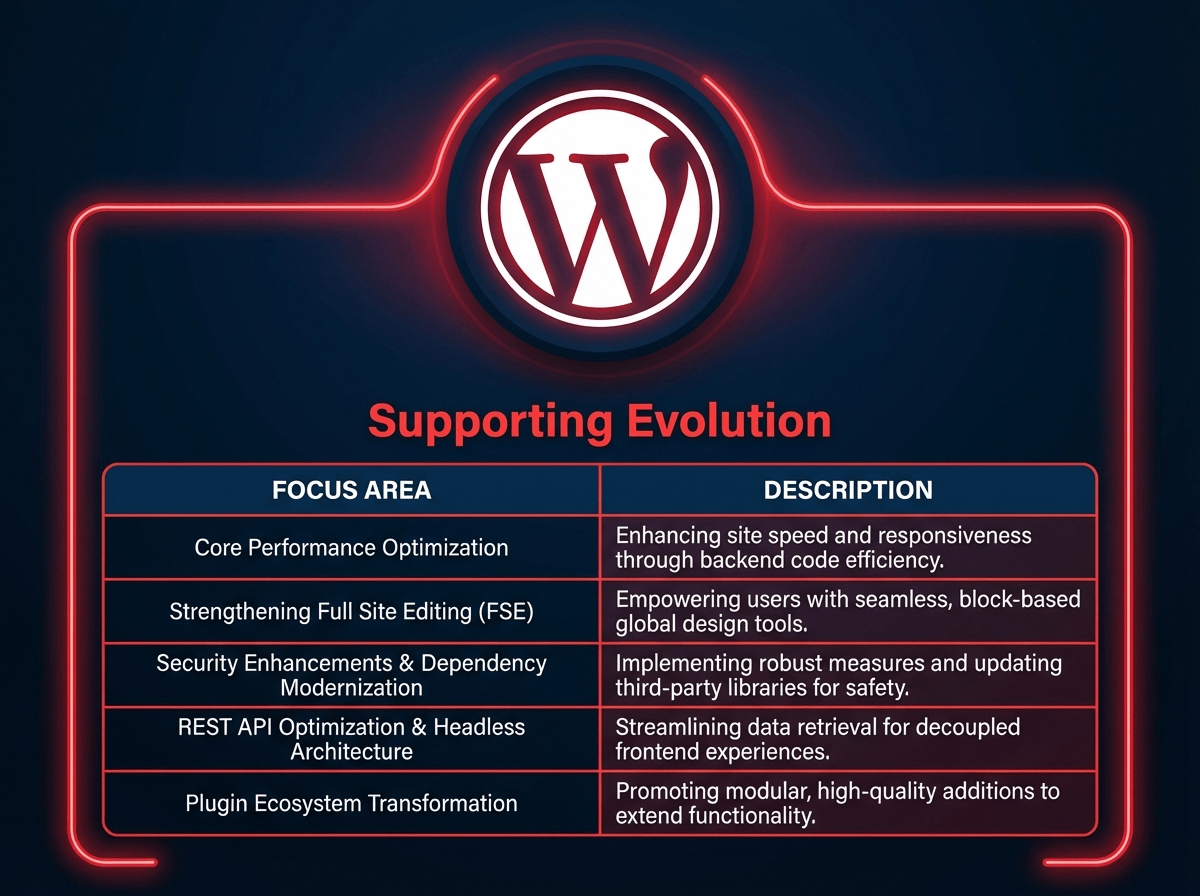
Supporting Evolution
Core Performance Optimization:
WordPress is becoming increasingly aggressive in improving performance natively. With refinements in lazy loading, script loading optimization (defer & async), and the reduction of render-blocking resources, websites can run faster without relying on heavy additional plugins.
Strengthening Full Site Editing (FSE):
The block-based approach has now matured into the new standard for website development. Through Full Site Editing, managing layouts—from headers and footers to templates—can be done directly without external page builders, creating a more efficient and lightweight workflow.
Security Enhancements & Dependency Modernization:
WordPress continues to update its technological foundation by reducing legacy code and increasing compatibility with the latest PHP versions. This step not only strengthens system security but also ensures stability for large-scale and enterprise needs.
REST API Optimization & Headless Architecture:
Support for the REST API has been further enhanced to meet the demands of modern architecture. WordPress is now more ready to be used as a backend in headless scenarios, allowing for more flexible integration with various frontend frameworks and digital applications.
Plugin Ecosystem Transformation:
The plugin ecosystem is shifting toward a more lightweight and modular approach. Many functions that previously relied on plugins are now integrated into the core, thereby reducing complexity, improving performance, and simplifying long-term maintenance processes.
New Challenges: Why is Legacy WordPress Starting to Feel "Cluttered"?
While WordPress continues to evolve with various modern updates, the reality is that many websites still operate using outdated approaches. This mismatch creates a performance gap that has become increasingly noticeable in 2026.
Here are the primary challenges often hindering website growth:
The "Website Obesity" Phenomenon (Bloatware):
Using too many plugins for minor functions ends up weighing down the entire system. Every plugin brings additional scripts, styles, and processes that drag down performance. Consequently, the website loses the speed and responsiveness that are now considered the baseline standard.
Accumulation of Technical Debt:
Many websites still rely on legacy themes or code that is no longer relevant to the latest WordPress versions. This condition doesn't just impact the visual appearance; it creates a fragile system structure that is difficult to develop and prone to performance degradation.
Increasingly Stringent Performance Standards:
Digital performance expectations continue to rise. Websites that fail to load quickly risk losing visibility and engagement. In today's digital ecosystem, speed is no longer an advantage—it is a fundamental requirement.
Non-Adaptive User Experience (UX):
Modern users are accustomed to instant and responsive applications. Websites with slow loading, rigid navigation, or delayed interactions are easily abandoned, often before the main message is even delivered.
Transformation Strategy: "Lean" Solutions for Resilient Websites
Facing various performance challenges in the modern era, transforming into a leaner system is no longer an option, but a necessity. To optimize WordPress's potential in 2026, a strategic approach focused on efficiency, speed, and scalability is required.
Here are the tactical steps that can be implemented:
Utilization of the Native Block System (Gutenberg):
Reducing dependency on third-party page builders and switching to WordPress's native block system allows the website structure to become more lightweight and efficient. With this approach, code overhead can be minimized while simultaneously improving page rendering performance.
Optimization and Script Cleanup:
Every page should only load the resources that are actually needed. By selectively controlling the loading of scripts and styles, a website can avoid irrelevant overhead, thereby significantly increasing access speeds.
Process Distribution via API:
For complex functions such as booking systems, payments, or automation, using external APIs is an effective solution. This approach allows the main server to stay focused on delivering content, while heavy processes are run separately and more efficiently.
Implementation of a Smart Caching System:
Applying an optimal caching system allows pages to load faster by storing frequently accessed data. This provides a more responsive user experience, especially for returning visitors.
While these strategies provide a clear direction for building a lean and high-performance website, the real challenge often lies in execution. Many businesses already understand what needs to be improved, but struggle to implement these changes without disrupting existing systems or creating new technical issues.
Transforming a website is not simply about adding or removing tools—it requires a structured approach, technical precision, and a deep understanding of how each component works together. This is where having the right expertise becomes critical to ensure that every improvement delivers measurable impact.
Executing Website Transformation with RN Tech
Once a lean strategy is applied, the next challenge is ensuring that implementation runs optimally and remains sustainable. RN Tech is here to bridge the complexity of the latest technologies with real-world business needs.
Code Refactoring for Performance:
Optimizing website structure by reducing bloatware and maximizing the use of WordPress native blocks, ensuring every page is faster and more responsive.
Building Future-Ready Architecture:
Implementing systems that are ready to adapt to algorithm updates and AI technology, guaranteeing the website remains relevant in a rapidly changing digital era.
Ensuring Local Relevance:
Tailoring system integration and server optimization according to the characteristics of the Malaysian market, ensuring maximum speed, security, and user experience.
Maintaining Sustainable Performance:
Applying real-time monitoring, controlled system updates, and infrastructure-based protection, so that optimization does not stop after the initial implementation.
FAQ: WordPress Website Optimization 2026
1. Why does my old website feel slow even after updating WordPress?
Legacy websites are often "obese" due to excessive plugins, outdated themes or code (technical debt), and unoptimized scripts. Without refactoring and a lean strategy, performance remains hindered even when using the latest WordPress version.
2. What is High-Performance Order Storage (HPOS) in WooCommerce?
HPOS is a specialized data storage system for e-commerce transactions. With HPOS, order processing becomes up to 50% faster, making the customer shopping experience instantaneous and more reliable.
3. How do I leverage the Interactivity API & Native Blocks?
With the Interactivity API, interactive elements run natively without the need for third-party JavaScript. Native Blocks (Gutenberg) allow for flexible design and layouts without adding system overhead, making the website lighter and faster.
4. What is RN Tech's role in website transformation?
RN Tech helps implement lean strategies and modern architecture by:
- Refactoring code to reduce bloatware.
- Building scalable and AI-ready architecture.
- Integrating systems based on local requirements.
- Ensuring sustainable performance through monitoring, controlled updates, and infrastructure-based protection.
5. How can I keep website performance optimal after implementation?
- Use real-time monitoring to detect issues early.
- Apply controlled system updates within a staging environment.
- Use server-based protection (e.g., Cloudflare) for security without weighing down WordPress.
6. Is this strategy relevant for local businesses in Malaysia?
Yes. RN Tech tailors optimization, servers, and system integrations to the characteristics of the Malaysian digital market, ensuring that speed, security, and user experience remain maximized.
Conclusion
WordPress transformation in 2026 is more than just a technical update—it is a journey toward building a fast, lightweight, and sustainable website. From core updates like HPOS and the Interactivity API to lean strategies and real-world execution with RN Tech, every step is designed to ensure your website is not only fast on day one but remains optimal every single day.
RN Tech serves as a partner that bridges strategy with implementation, assisting in code refactoring, building scalable and AI-ready architectures, and tailoring optimization to local market characteristics. With this approach, your website remains relevant, secure, and prepared for future digital challenges.
If you want your business website to be ready for 2026 digital standards, learn how RN Tech can help enhance your website's performance, security, and user experience.