The Future of SEO in Malaysia Is System-Based
Sunday, May 10, 2026
In modern digital ecosystems, especially in highly competitive regions like Klang Valley, SEO is no longer a standalone marketing tactic. It has evolved into a system of interconnected technical, content, and behavioral layers that determine how visibility is distributed across search platforms.
Businesses that still treat SEO as simple content production are gradually losing structural advantage in search performance.
Instead, SEO must be understood as a system of digital architecture—where structure, intent, and user behavior are engineered together to influence visibility and outcomes.
RN Tech approaches SEO as a system, designed to build sustainable digital dominance beyond rankings alone.
Why Most SEO Strategies Fail
Most SEO strategies fail not because of execution, but because of how they are fundamentally structured.
Many businesses still approach SEO as a content-driven activity—focusing on keywords, volume, and publishing frequency—while ignoring the underlying system that determines visibility.
As a result, they compete on output rather than structure, making their growth difficult to sustain.
1. SEO is Treated as a Campaign, Not a System
Most businesses deploy SEO as short-term campaigns instead of long-term system architecture. This creates unstable rankings and inconsistent visibility.
2. Fragmented Digital Architecture
Websites are built without structural integration between technical performance, content hierarchy, and search intent mapping.
3. Lack of AI Search Readiness
Most SEO systems are not optimized for AI-driven search environments, limiting visibility in next-generation discovery systems.
The RN Tech SEO Framework
SEO performance is not the result of isolated tactics, but the outcome of a structured system.
At RN Tech, we approach SEO as an engineered framework—where technical infrastructure, content architecture, and search behavior are integrated into a unified system.
This framework is designed to create sustainable visibility by aligning how search engines interpret structure with how users express intent.
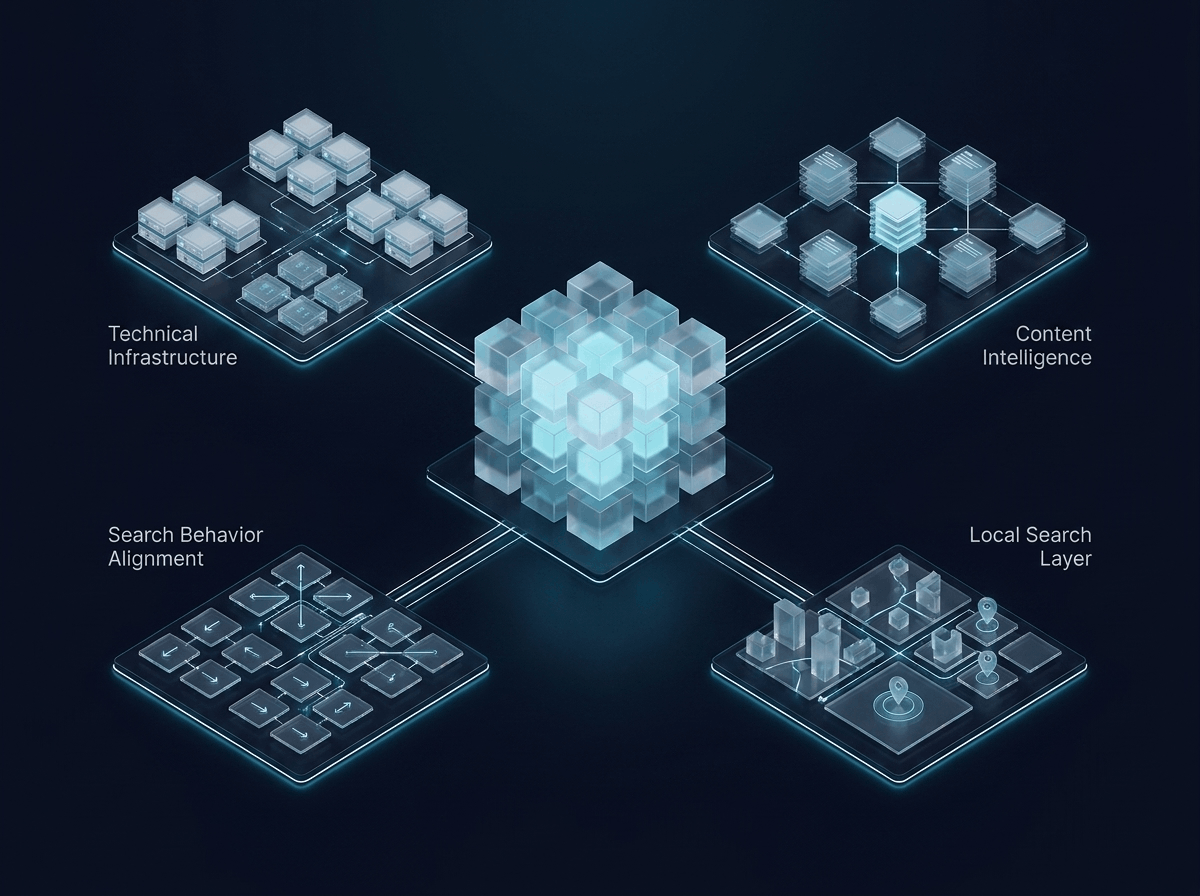
The RN Tech SEO Framework is designed as an interconnected system where technical infrastructure, content intelligence, search behavior, and localized visibility operate in alignment.
1. Technical SEO System Architecture
We design and rebuild website infrastructure to ensure maximum crawl efficiency, speed optimization, and structured data integrity.
This includes:
- Core Web Vitals optimization
- Clean code architecture (no bloat systems)
- Structured schema implementation
2. Content Intelligence System
Content is engineered as a system of interconnected topical clusters, designed to build authority across search ecosystems.
3. Search Behavior Alignment System
We map user intent patterns to ensure content aligns with real search behavior, not assumptions.
4. Local Search System Layer
We design localized SEO systems that adapt to high-value commercial ecosystems, ensuring visibility in competitive markets where search intent is strongly tied to geography and buying behavior.
In markets such as Kuala Lumpur and surrounding economic hubs, this system ensures that digital presence is not only visible—but structurally positioned to capture high-intent demand.
What Makes SEO Systems Different From Traditional SEO
Traditional SEO is built around isolated tactics—keywords, content production, and backlink acquisition—executed as separate activities.
In contrast, SEO systems are designed as integrated structures, where technical foundations, content architecture, and search behavior operate as a unified whole.
The difference is not in what is done, but in how it is structured. While traditional SEO focuses on output, SEO systems focus on alignment—ensuring that every layer of the digital ecosystem contributes to visibility in a coordinated way.
Traditional SEO vs System-Based SEO
| Traditional SEO | SEO Systems (RN Tech) |
|---|---|
| Focuses on keywords as isolated targets | Builds structured search ecosystems driven by intent and context |
| Content-driven execution (publish & optimize) | System-driven architecture (design, integrate, and scale) |
| Relies on short-term ranking improvements | Engineered for long-term visibility and compounding growth |
| Operates in fragmented workflows (tech, content, UX separated) | Integrates technical, content, and behavioral layers into one system |
| Reactive updates based on performance drops | Proactive system optimization based on data and intent signals |
| Manual execution and ongoing adjustments | Automated and structured processes designed for scalability |
| Competes on content volume and frequency | Competes on structural advantage and relevance alignment |
The shift from traditional SEO to system-based SEO is not a tactical upgrade—it is a structural transformation.
Visibility is no longer determined by what you publish, but by how your entire digital system is designed to align with search behavior.
Business Impact: What Digital Dominance Actually Means
Digital dominance is not defined by visibility alone, but by becoming the most trusted and default choice within search ecosystems.
When SEO is structured as a system rather than a set of tactics, the business impact extends beyond rankings and directly influences revenue quality, acquisition efficiency, and brand authority.
.png)
A visual representation of SEO as a connected ecosystem where visibility, trust, and conversion work as a unified system driving sustainable revenue growth.
This shift creates compounding advantages across the entire digital funnel:
- Higher-quality organic conversions driven by intent-aligned traffic
- Reduced dependency on paid acquisition channels
- Stronger and more consistent brand authority signals across search platforms
- Sustainable, search-driven revenue growth that compounds over time
Final Positioning
SEO is no longer a collection of tactics competing for rankings—it is a structured system that determines how digital visibility, authority, and revenue are distributed across search ecosystems.
Traditional SEO focuses on short-term optimization: keywords, content output, and isolated improvements. However, in increasingly competitive digital environments, this approach is no longer sufficient to sustain long-term growth.
The shift toward system-based SEO represents a fundamental change in how visibility is built. Instead of optimizing individual elements, businesses must design interconnected systems where technical infrastructure, content architecture, and user intent work as a unified framework.
RN Tech operates within this paradigm shift—building SEO systems that prioritize structure over activity, alignment over volume, and compounding visibility over temporary rankings.
The future of SEO is not about doing more. It is about building correctly from the start.
If your SEO strategy is still operating as a set of disconnected tactics, it is already structurally limited in performance.
RN Tech helps businesses transition from traditional SEO execution to system-based search architecture—designed for sustainable visibility, stronger authority, and long-term digital dominance.
If you are building for scale, not short-term rankings, this is the direction forward.