Mobile Commerce Optimization Guide to Increase Sales in Malaysia
Monday, February 2, 2026
Consumer demand for smartphones and other mobile devices for online shopping and browsing is growing rapidly. In Malaysia, smartphone penetration has reached exceptionally high levels, fueled by evolving shopping habits that lean heavily toward marketplaces and social commerce platforms year after year.
Today, the vast majority of internet traffic originates from mobile devices. This reality dictates that establishing a mobile-friendly website and holistically optimizing your online store is no longer optional—it has become a strategic necessity for businesses looking to effectively reach today’s fast-moving, mobile-first consumers (mobile-first consumers).
The exponential expansion of mobile commerce (m-commerce) is fundamentally rewriting the rules of engagement between brands and consumers. Modern buyers rely on their smartphones to transact anytime and anywhere, often capitalising on brief micro-moments throughout their day. To capture these mobile buyers efficiently, enterprises must guarantee that their digital infrastructure delivers blistering loading speeds and flawless functionality across smaller screens.
Understanding Mobile Users Psychology and Local Buying Behavior
Mobile user behavior differs substantially from desktop users. In the Malaysian market, a significant percentage of consumers browse online stores while commuting, during work breaks, or while casually scrolling through social media. A defining characteristic of this activity is that it predominantly occurs over mobile data networks rather than stable home or office Wi-Fi connections, rendering performance optimization an absolute priority.
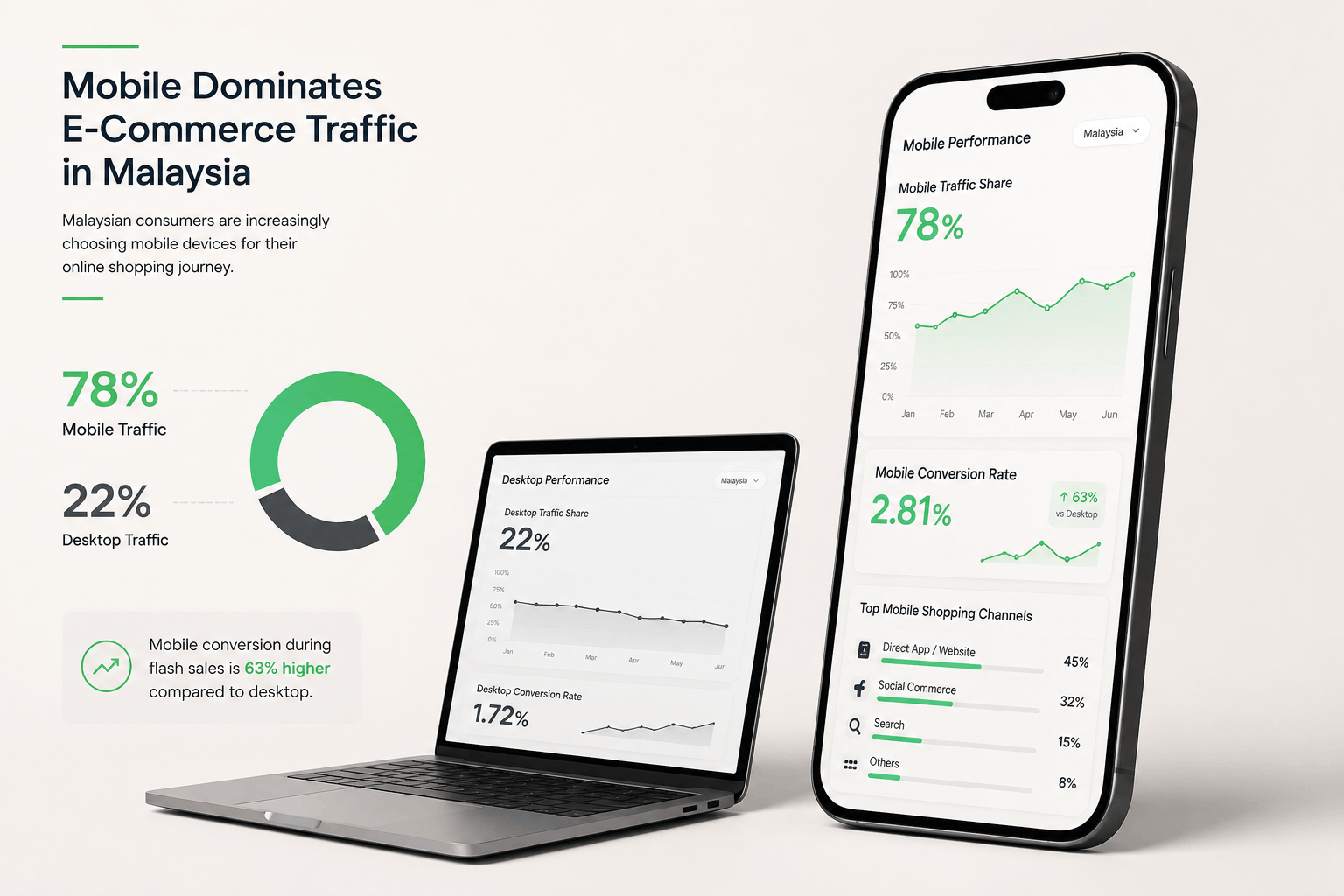
A digital performance infographic demonstrating the absolute dominance of mobile traffic at 78% compared to desktop traffic at 22% within the Malaysian e-commerce market. The data indicates a mobile conversion rate of 2.81% (outperforming desktop by 63%, particularly during flash sales), with top mobile shopping channels led by direct apps/websites (45%) and social commerce (32%).
Several key behavioral patterns stand out within the Malaysian mobile market:
- High Mobility: Users constantly transition between different environments, including homes, offices, and public transportation.
- Inconsistent Connectivity: Mobile network speeds can fluctuate dramatically, particularly when users travel outside major urban economic zones.
- Physical Navigation Barriers: Touchscreen interactions on small devices necessitate highly intuitive and meticulously spaced user interfaces.
- Compressed Attention Spans: Mobile consumers exhibit shorter attention thresholds, with purchase decisions heavily influenced by instantaneous impulses.
Key Local Insight: Malaysian consumers are exceptionally responsive to flash sales, free shipping offers, and personalized push notifications. Their speed of conversion when interacting with mobile promotions is documented to be far more aggressive than traction generated via desktop environments.
Improving Mobile E-Commerce Performance & Funnel Speed
After deciphering user psychology, the next strategic imperative involves upgrading mobile performance holistically. Businesses should prioritize eliminating non-essential content and adopting a clean, responsive layout. A minimalist design approach helps users focus instantly on what matters most, such as best-selling product lines and primary calls to action displayed on streamlined landing pages or concise funnels. Furthermore, integrating a thumb-friendly design has become an industry standard to accommodate natural, single-handed phone usage.
Content delivery speed remains the ultimate make-or-break factor for any conversion funnel. Research indicates that websites or advertising landing pages requiring more than three seconds to load risk losing the vast majority of their incoming traffic.
In the Malaysian business context, this is critical because network quality outside the Klang Valley region can still experience uneven stability. To unlock maximum technical performance, the following protocols must be deployed:
- Compressing images into cutting-edge modern formats (such as WebP or AVIF).
- Utilizing robust regional Content Delivery Networks (CDNs).
- Minimizing heavy third-party scripts and optimizing complex JavaScript execution.
- Enabling lazy loading mechanisms to maximize initial data delivery efficiency.
Streamlining Mobile Checkout
The checkout experience is the ultimate tipping point where hard-earned traffic is either converted into revenue or permanently lost to cart abandonment. Mobile users possess zero tolerance for long, tedious, or ambiguous digital forms. Eradicating friction during these final steps will immediately yield a measurable lift in transaction volume.
Deploying Efficient UI/UX
Enterprises can drastically simplify data entry by implementing intelligent autofill features, smart form detection, and seamless social login integrations. Furthermore, prioritizing guest checkout availability ensures that high-intent buyers can complete purchases without being forced through a time-consuming registration pipeline.
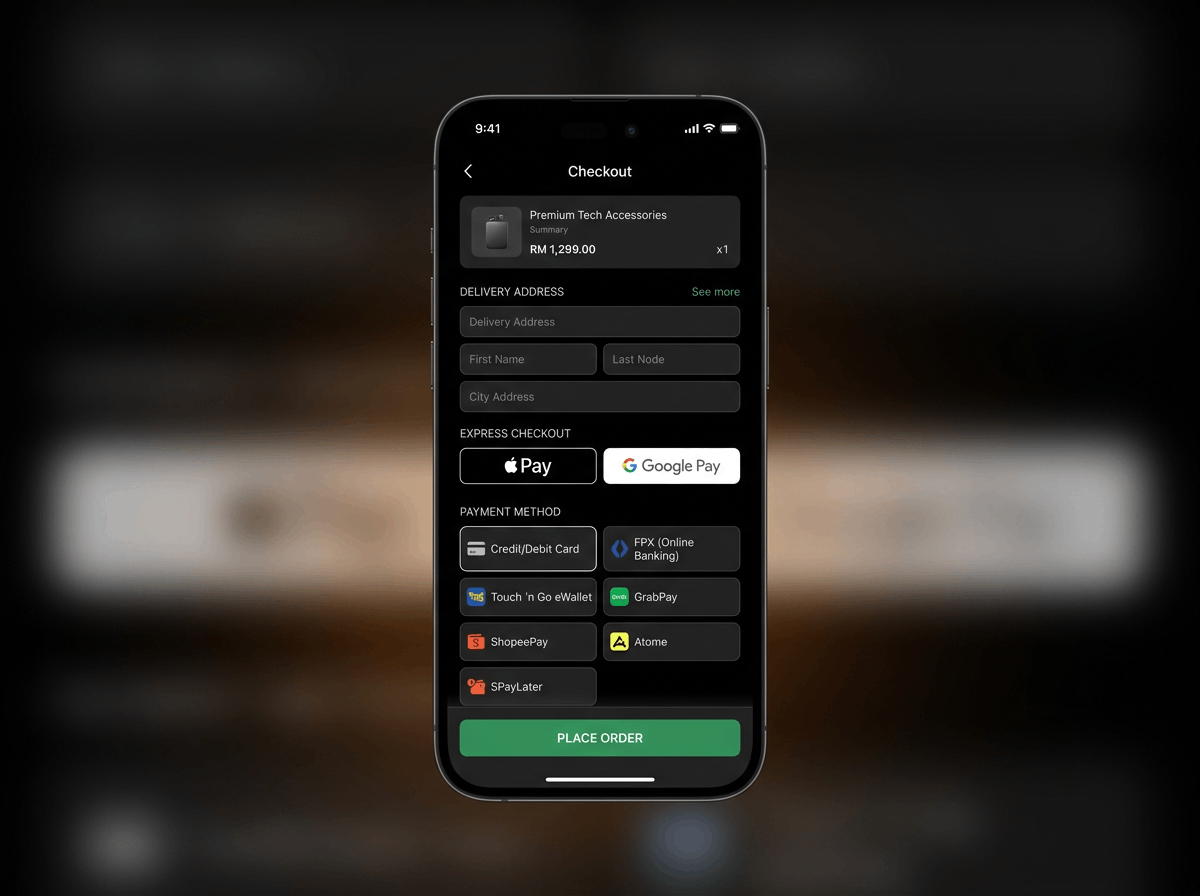
An enterprise-grade example of a mobile One-Page Checkout architecture engineered for maximum conversion efficiency. This streamlined interface eliminates form-filling friction for consumers and natively integrates the local Malaysian payment ecosystem, featuring FPX, Touch 'n Go eWallet, GrabPay, ShopeePay, and Buy Now Pay Later (BNPL) services like Atome and SPayLater to drastically minimize cart abandonment.
Integrating the Local Malaysian Payment Ecosystem
To secure optimal conversion rates within the local market, e-commerce systems must fully support the payment gateways native to Malaysian consumer preferences, including:
- FPX Online Banking: Direct and secure routing to major local banking institutions.
- Dominant E-Wallets: Flawless integration with Touch ’n Go eWallet, GrabPay, and ShopeePay.
- Buy Now Pay Later (BNPL) Services: Providing flexible financing alternatives such as Atome or SPayLater to naturally elevate Average Order Value (AOV).
Securing Mobile Traffic via Advanced PWA and Cloaking Solutions
For scaling e-commerce brands and enterprises driving aggressive customer acquisition funnels via paid media (Facebook Ads, Google Ads, or TikTok Ads), standard aesthetic optimization is no longer a sufficient defense. The single greatest operational hazard confronting modern digital advertisers is the aggressive policing and automated compliance bots of major ad networks, which frequently trigger sudden ad account bans due to oversensitive platform algorithms.
As a pioneer in high-performance enterprise digital solutions, RN Tech delivers a definitive solution by combining Progressive Web Apps (PWA) with an Advanced Cloaking Solution architecture. This engineering framework is tailored precisely to shield your advertising capital while maintaining a superior mobile conversion ecosystem.
The Combined Power of PWA & Funnel Cloaking
PWA technology allows your digital storefront to operate with the native speed and responsiveness of a dedicated mobile application, running incredibly lightweight even on mid-to-low-tier Android devices that dominate the Malaysian market demographic. When paired with RN Tech’s proprietary cloaking deployment, your server infrastructure gains the real-time intelligence to accurately bifurcate incoming traffic:
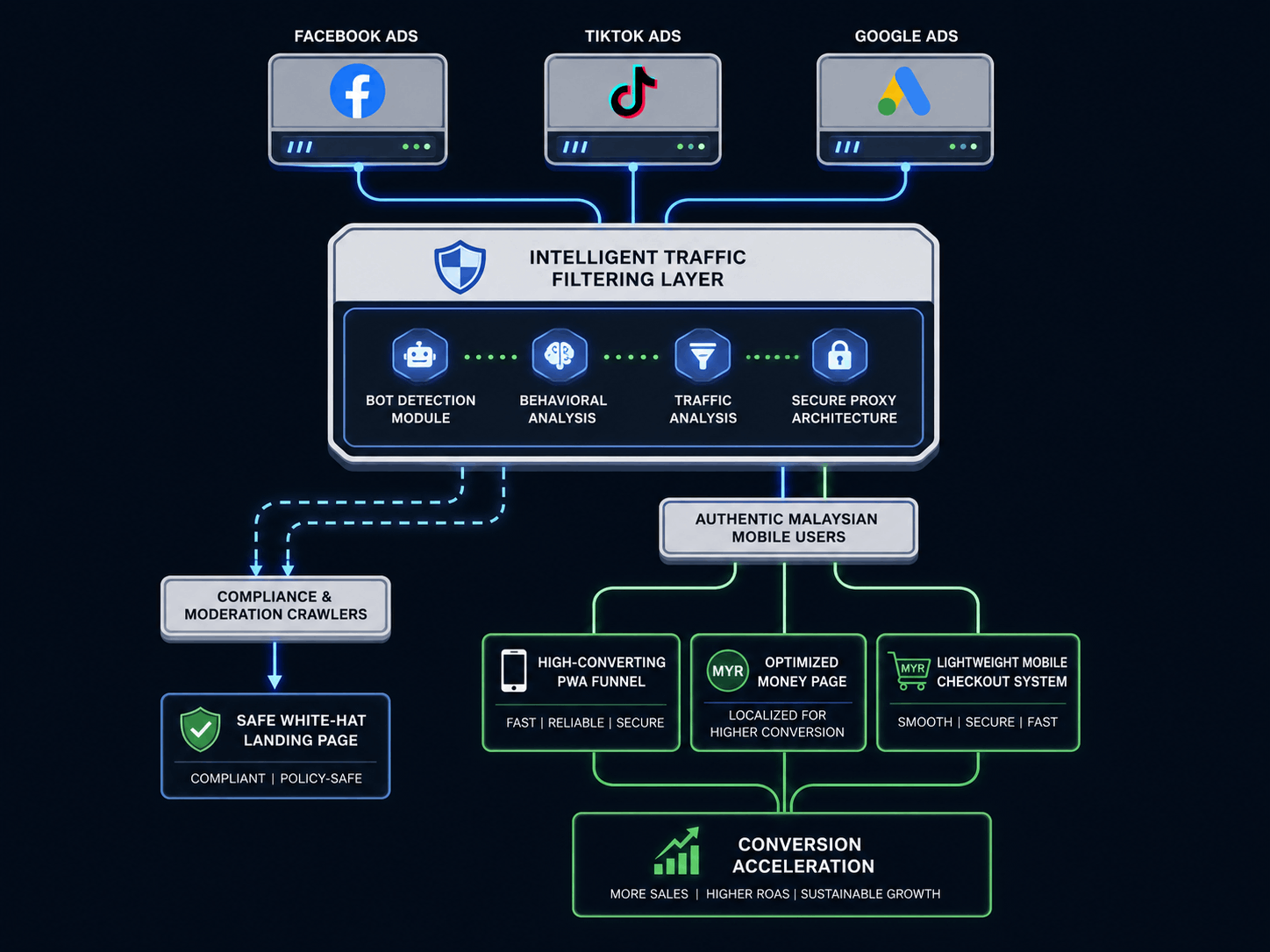
RN Tech's digital infrastructure architecture diagram illustrating the workflow of the Intelligent Traffic Filtering Layer. The system automatically filters incoming traffic from Facebook Ads, TikTok Ads, and Google Ads through bot detection and behavioral analysis modules. Traffic from moderation bots (Compliance & Moderation Crawlers) is safely routed to a Safe White-Hat Landing Page, while authentic Malaysian mobile users are directed to a high-converting PWA ecosystem and optimized money pages to accelerate conversions and protect advertising assets.
- Compliance Bot Filtering: When the system identifies access attempts from automated ad network crawlers, moderation bots, or platform reviewers (Facebook/TikTok), our advanced cloaking mechanisms (leveraging Reverse Proxy, Iframe, or HTML/JavaScript Injection) dynamically serve a pristine, fully policy-compliant, white-hat safe page.
- Real Human User Routing: When the system authenticates the traffic as a genuine human consumer located in Malaysia, it instantly routes them to your high-converting primary sales funnel, interactive bridge pages, or lightning-fast PWA asset designed for immediate conversion.
This dual-layer strategy successfully bulletproofs your advertising operations against systemic bans, ensuring your marketing expenditures are entirely directed toward active consumers at maximum speeds.
Strategic Challenges and Operational Risks to Anticipate
While the revenue upside of aggressive, optimized mobile commerce is immense, corporate decision-makers must maintain clear visibility over specific technical and operational challenges to avoid implementation failures:
- Severe Device Fragmentation: The Malaysian mobile landscape features an incredibly wide spectrum of devices, ranging from entry-level Android builds to elite flagship models. This fragmentation demands professional-grade script optimization and robust code compilation to prevent visual and functional glitches.
- The Risk of Over-Optimization: Unstructured stacking of multiple tracking pixels, analytic frameworks, and intrusive third-party popups can overwhelm the device's processing memory, severely degrading web loading velocity.
- Regulatory Data Privacy Compliance (PDPA): All user tracking configurations, pixel deployments, and payment processing steps must operate strictly within the legal boundaries of Malaysia's Personal Data Protection Act (PDPA) to safeguard the enterprise from severe legal liabilities and brand damage.
- Dependence on Enterprise Technical Expertise: Attempting to engineer complex Reverse Proxy networks or PWA Cloaking setups using generic, off-the-shelf software without deep infrastructure knowledge exposes your digital assets to bot leaks, triggering immediate and permanent domain blacklisting.
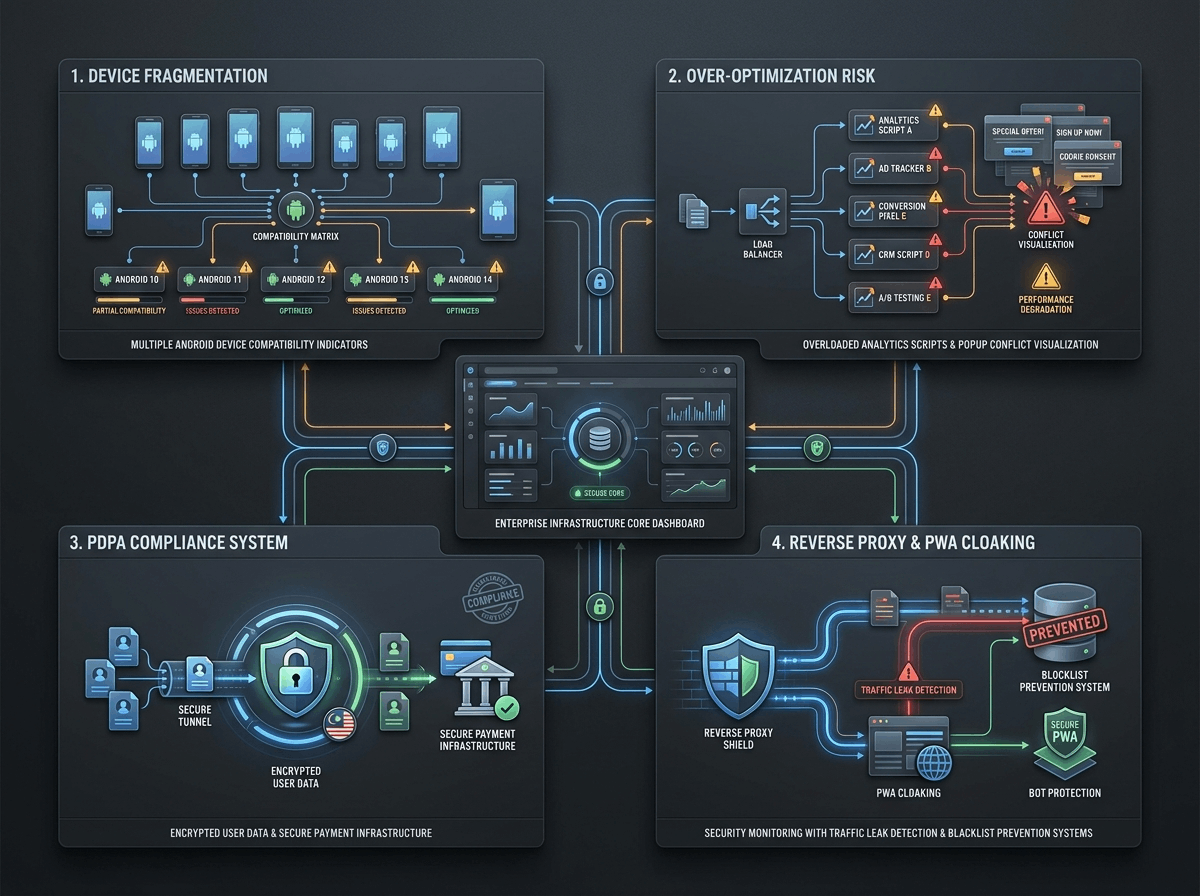
RN Tech’s core enterprise infrastructure dashboard layout for mitigating mobile commerce operational risks. The diagram integrates (1) a compatibility matrix addressing Android device fragmentation in Malaysia, (2) script load management to prevent performance degradation, (3) user data encryption compliant with local PDPA regulations, and (4) a unified Reverse Proxy and PWA Cloaking architecture providing robust traffic leak detection and ad network blocklist prevention.
The Business Impact of Mobile Optimization & Traffic Security
Executing a fortified, highly optimized mobile framework yields profound commercial returns across your entire digital enterprise. Organizations that commit to this architecture consistently observe measurable upturns in performance metrics:
- Unprecedented Ad Campaign Stability: Advertising accounts experience prolonged operational lifespans, empowering marketing teams to aggressively scale budget allocations without the constant threat of disruption.
- Surging Conversion Percentages: Eliminating user experience friction and speed bottlenecks directly drives conversion performance, routinely pushing mobile conversion rates upward by 10% or more.
- Optimized Return on Ad Spend (ROAS): Blistering loading velocities eliminate bounce rates, guaranteeing that every ad click paid for translates into an active, valuable customer session.
- Heightened Brand Equity & Customer Retention: A lightning-fast, ultra-secure, and professionally executed transaction flow instantly cements credibility with local Malaysian buyers, stimulating strong customer lifetime value and consistent repeat purchasing.
Practical Ways to Lift Mobile Conversion
For enterprises seeking immediate execution strategies to unlock trapped revenue from mobile traffic streams, the following high-performance tactics should be engineered into your digital platforms immediately:
- Deploy One-Page Checkout: Consolidate shopping carts, delivery metrics, and payment gateway selections into a singular, fluid interface to instantly strip away transactional friction.
- Utilize High-Speed Bridge Pages: Implement highly optimized intermediate pages engineered with lightweight HTML/JS configurations to generate instant micro-commitments before routing users into the main transaction engine.
- Incorporate Tap-to-WhatsApp Features: Capitalizing on the explicit preference of Malaysian consumers for direct, conversational commerce, embedding direct-to-WhatsApp communication channels yields significantly higher closing metrics than legacy email support desks.
- Architect Server-Side Reverse Proxies: Deploy a server-side Reverse Proxy architecture to refine data transmission pathways, accelerate server response times, and obscure the technical footprint of third-party monitoring entities.
Conclusion
Within Malaysia’s high-velocity digital economy, mobile performance optimization and the proactive safeguarding of advertising traffic are no longer mere competitive advantages—they are the core determinants of your e-commerce enterprise's survival. The brands that dominate the market are those capable of delivering an instantaneous, frictionless, and secure mobile buying journey for local consumers, while intelligently defending their advertising infrastructure from automated global platform restrictions.
If you are prepared to accelerate your mobile e-commerce trajectory, eliminate the operational headache of ad account suspensions, and deploy enterprise-grade PWA Cloaking, Bridge Funnels, or Reverse Proxy solutions seamlessly, RN Tech is your definitive strategic partner. Combining deep systems engineering capabilities with comprehensive insight into the nuances of the Malaysian market, RN Tech is equipped to transform your digital traffic into predictable, scaling profitability.
Accelerate Digital Infrastructure and Secure Your E-Commerce Campaigns with RN Tech
In an era where the volatility of global advertising platform policies can halt your business operations overnight, relying on standard web architecture is an unsustainable risk. RN Tech operates not merely as a web development agency, but as your Strategic Infrastructure Engineering Partner, dedicated to ensuring business continuity and maximizing return on ad spend (ROAS) within the Malaysian market.
We invite executives, brand owners, and digital leaders to transition from vulnerable, legacy infrastructures to a resilient, high-speed, and bulletproof digital ecosystem.
Why Partner with RN Tech?
- High-Performance Custom PWA Architecture: We engineer e-commerce storefronts that are ultra-lightweight, responsive, and adaptive to device fragmentation and network fluctuations across all Malaysian regions.
- Enterprise-Grade Cloaking & Proxy Systems: State-of-the-art protection leveraging Reverse Proxy and HTML/JS Injection to shield your advertising assets from oversensitive global platform compliance bots.
- Localized FinTech Ecosystem Integration: Streamlining transaction pipelines via native integration with Malaysia’s primary payment gateways (FPX, Touch 'n Go, GrabPay, Atome, SPayLater) to drastically reduce cart abandonment.
Let’s Build a More Resilient Digital Foundation Together. Every business deserves a smooth and reliable path to growth in Malaysia's mobile market. Whether you are looking to enhance your web performance, elevate the customer checkout experience, or ensure greater peace of mind for your advertising campaigns, RN Tech is here to support you. Our strategic consultants are ready to listen and help tailor the right infrastructure solutions for your business goals.
Contact RN Tech today to start a collaborative conversation with our team.